
최신CIPS Global Commercial Strategy - L6M2무료샘플문제
문제1
SIMULATION
Discuss the role and influence of industry regulators and international bodies in the business environment.
SIMULATION
Discuss the role and influence of industry regulators and international bodies in the business environment.
정답:
The Role and Influence of Industry Regulators and International Bodies in the Business Environment Introduction Industry regulators and international bodies play a critical role in shaping the business environment by enforcing regulations, setting industry standards, and ensuring fair competition. These organizations influence how businesses operate, impacting areas such as trade, finance, environmental sustainability, labor practices, and consumer protection.
Companies must comply with regulations set by both domestic industry regulators and global institutions to maintain legal and ethical business operations.
1. Role of Industry Regulators
Industry regulators are government-appointed or independent organizations that oversee specific sectors to ensure compliance with laws and standards. Their key functions include:
✅ Enforcing Compliance - Ensuring companies adhere to legal requirements (e.g., financial reporting, safety regulations).
✅ Promoting Fair Competition - Preventing monopolies and anti-competitive practices.
✅ Consumer Protection - Safeguarding consumer rights and ensuring product/service quality.
✅ Regulating Market Entry and Operations - Setting standards for licensing, pricing, and ethical conduct.
Example of Industry Regulators
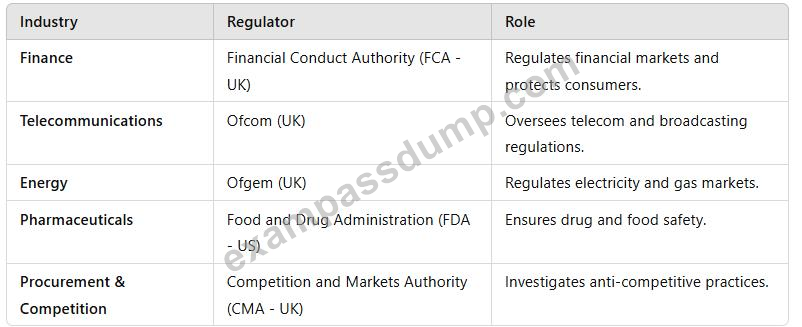
Case Example: The UK's Competition and Markets Authority (CMA) blocked Microsoft's acquisition of Activision Blizzard due to concerns over market dominance in cloud gaming.
2. Role of International Bodies
International bodies set global regulations, trade policies, and ethical standards that influence businesses operating across borders.

Case Example: The WTO's intervention in Brexit trade negotiations affected tariffs and supply chain costs for UK-based companies.
3. Influence of Industry Regulators and International Bodies on Business Strategy Businesses must align their strategies with regulatory and international frameworks to ensure compliance and avoid financial or reputational risks.
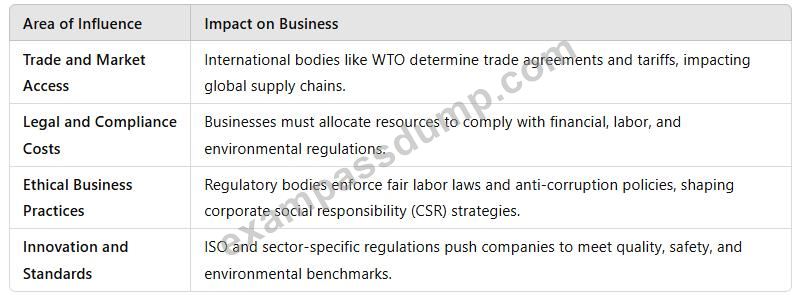
Example: The EU's General Data Protection Regulation (GDPR) forced global companies to enhance data protection policies or face heavy fines.
4. Advantages and Disadvantages of Regulatory and International Influence
✅ Advantages
Promotes Stability & Fair Competition - Reduces market manipulation and corruption.
Protects Consumers & Employees - Ensures safety, fair wages, and ethical standards.
Encourages Innovation & Sustainability - Businesses invest in R&D to meet regulatory requirements.
Facilitates Global Trade - International trade agreements create business opportunities.
❌ Disadvantages
Regulatory Burdens & Compliance Costs - Strict laws increase operational costs.
Trade Barriers & Bureaucracy - Lengthy regulatory approval processes slow down market entry.
Risk of Overregulation - Too many rules can stifle competition and innovation.
Example: The EU Emissions Trading System (EU ETS) requires manufacturers to pay for carbon emissions, increasing operational costs.
Conclusion
Industry regulators and international bodies shape the business environment by enforcing laws, ensuring ethical practices, and facilitating global trade. Companies must proactively monitor regulatory changes, integrate compliance into strategic planning, and adapt to international standards to maintain market competitiveness and sustainability.
Companies must comply with regulations set by both domestic industry regulators and global institutions to maintain legal and ethical business operations.
1. Role of Industry Regulators
Industry regulators are government-appointed or independent organizations that oversee specific sectors to ensure compliance with laws and standards. Their key functions include:
✅ Enforcing Compliance - Ensuring companies adhere to legal requirements (e.g., financial reporting, safety regulations).
✅ Promoting Fair Competition - Preventing monopolies and anti-competitive practices.
✅ Consumer Protection - Safeguarding consumer rights and ensuring product/service quality.
✅ Regulating Market Entry and Operations - Setting standards for licensing, pricing, and ethical conduct.
Example of Industry Regulators
Case Example: The UK's Competition and Markets Authority (CMA) blocked Microsoft's acquisition of Activision Blizzard due to concerns over market dominance in cloud gaming.
2. Role of International Bodies
International bodies set global regulations, trade policies, and ethical standards that influence businesses operating across borders.
Case Example: The WTO's intervention in Brexit trade negotiations affected tariffs and supply chain costs for UK-based companies.
3. Influence of Industry Regulators and International Bodies on Business Strategy Businesses must align their strategies with regulatory and international frameworks to ensure compliance and avoid financial or reputational risks.
Example: The EU's General Data Protection Regulation (GDPR) forced global companies to enhance data protection policies or face heavy fines.
4. Advantages and Disadvantages of Regulatory and International Influence
✅ Advantages
Promotes Stability & Fair Competition - Reduces market manipulation and corruption.
Protects Consumers & Employees - Ensures safety, fair wages, and ethical standards.
Encourages Innovation & Sustainability - Businesses invest in R&D to meet regulatory requirements.
Facilitates Global Trade - International trade agreements create business opportunities.
❌ Disadvantages
Regulatory Burdens & Compliance Costs - Strict laws increase operational costs.
Trade Barriers & Bureaucracy - Lengthy regulatory approval processes slow down market entry.
Risk of Overregulation - Too many rules can stifle competition and innovation.
Example: The EU Emissions Trading System (EU ETS) requires manufacturers to pay for carbon emissions, increasing operational costs.
Conclusion
Industry regulators and international bodies shape the business environment by enforcing laws, ensuring ethical practices, and facilitating global trade. Companies must proactively monitor regulatory changes, integrate compliance into strategic planning, and adapt to international standards to maintain market competitiveness and sustainability.
문제2
SIMULATION
How can Minzburg's 5Ps assist an organisation to develop its global strategy?
SIMULATION
How can Minzburg's 5Ps assist an organisation to develop its global strategy?
정답:
Mintzberg's 5Ps and Global Strategy Development
Introduction
Henry Mintzberg's 5Ps of Strategy is a framework that helps organizations understand the multiple perspectives of strategy. It recognizes that strategy is not just a planned activity but evolves through deliberate and emergent actions. The 5Ps-Plan, Ploy, Pattern, Position, and Perspective-help organizations develop an effective global strategy by providing a structured approach to decision-making and competitive positioning.
1. Explanation of Mintzberg's 5Ps
Mintzberg's 5Ps define strategy in five different ways, which help in shaping an organization's global expansion and competitive positioning.
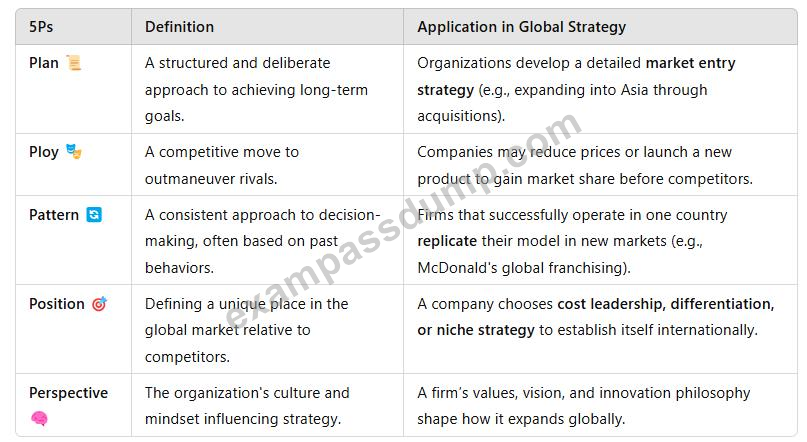
2. How Mintzberg's 5Ps Assist in Developing Global Strategy
1. Strategy as a Plan - Setting a Clear Direction for Global Expansion
Organizations develop structured strategic plans for international growth, including market research, investment strategies, and risk assessments.
Example: Tesla planned its global expansion into China by building a Gigafactory, ensuring supply chain efficiency and market entry success.
✅ Benefit: Ensures a structured, well-researched approach to global expansion.
2. Strategy as a Ploy - Gaining Competitive Advantage
Companies use strategic moves to block competitors or gain an early advantage in global markets.
Example: Amazon strategically enters new markets by offering discounts and acquiring local businesses to weaken competitors.
✅ Benefit: Helps organizations counter competition and establish dominance in new markets.
3. Strategy as a Pattern - Replicating Successful Models
If a company has a proven business model, it can apply the same strategy across different regions.
Example: McDonald's follows a pattern-based global expansion model, using standardized menus but adapting products to local tastes (e.g., McAloo Tikki in India).
✅ Benefit: Allows organizations to scale efficiently while maintaining consistency.
4. Strategy as a Position - Establishing a Competitive Market Position
Organizations must decide how they will compete globally-whether through cost leadership, differentiation, or niche markets.
Example: Apple positions itself as a premium brand worldwide, maintaining exclusivity through high pricing and innovation.
✅ Benefit: Helps organizations create a distinctive identity in international markets.
5. Strategy as a Perspective - Aligning Culture and Global Vision
A company's culture and values influence its global strategy.
Example: Patagonia's sustainability-first approach shapes its expansion into environmentally conscious markets, aligning with global CSR expectations.
✅ Benefit: Ensures global expansion aligns with the company's long-term values and mission.
3. Advantages of Using Mintzberg's 5Ps in Global Strategy Development
✅ Holistic Approach - Ensures strategy is not just a rigid plan but adapts to competition and market trends.
✅ Enhances Competitive Agility - Organizations can pivot between strategies (e.g., using a Ploy to disrupt competitors).
✅ Supports Market Adaptation - Helps companies apply Pattern-based expansion while considering local market needs.
✅ Aligns Corporate Vision with Market Positioning - The Perspective approach ensures expansion aligns with organizational values.
4. Limitations of Mintzberg's 5Ps in Global Strategy
❌ Lack of Emphasis on External Factors - Unlike PESTLE or Porter's Five Forces, the 5Ps focus mainly on internal strategy.
❌ Can Be Overly Conceptual - May lack specific actionable steps for implementing global expansion.
❌ Does Not Account for Rapid Market Changes - In fast-changing industries (e.g., tech), rigid strategic planning may become outdated quickly.
Solution: Combine 5Ps with external analysis tools (e.g., PESTLE for macro-environmental risks, BCG for product portfolio management).
Conclusion
Mintzberg's 5Ps of Strategy provide a comprehensive framework for developing global strategies, ensuring that businesses consider planning, competitive moves, consistency, positioning, and cultural alignment. However, it should be used in combination with other strategic models for a well-rounded approach to global expansion and decision-making.
Introduction
Henry Mintzberg's 5Ps of Strategy is a framework that helps organizations understand the multiple perspectives of strategy. It recognizes that strategy is not just a planned activity but evolves through deliberate and emergent actions. The 5Ps-Plan, Ploy, Pattern, Position, and Perspective-help organizations develop an effective global strategy by providing a structured approach to decision-making and competitive positioning.
1. Explanation of Mintzberg's 5Ps
Mintzberg's 5Ps define strategy in five different ways, which help in shaping an organization's global expansion and competitive positioning.
2. How Mintzberg's 5Ps Assist in Developing Global Strategy
1. Strategy as a Plan - Setting a Clear Direction for Global Expansion
Organizations develop structured strategic plans for international growth, including market research, investment strategies, and risk assessments.
Example: Tesla planned its global expansion into China by building a Gigafactory, ensuring supply chain efficiency and market entry success.
✅ Benefit: Ensures a structured, well-researched approach to global expansion.
2. Strategy as a Ploy - Gaining Competitive Advantage
Companies use strategic moves to block competitors or gain an early advantage in global markets.
Example: Amazon strategically enters new markets by offering discounts and acquiring local businesses to weaken competitors.
✅ Benefit: Helps organizations counter competition and establish dominance in new markets.
3. Strategy as a Pattern - Replicating Successful Models
If a company has a proven business model, it can apply the same strategy across different regions.
Example: McDonald's follows a pattern-based global expansion model, using standardized menus but adapting products to local tastes (e.g., McAloo Tikki in India).
✅ Benefit: Allows organizations to scale efficiently while maintaining consistency.
4. Strategy as a Position - Establishing a Competitive Market Position
Organizations must decide how they will compete globally-whether through cost leadership, differentiation, or niche markets.
Example: Apple positions itself as a premium brand worldwide, maintaining exclusivity through high pricing and innovation.
✅ Benefit: Helps organizations create a distinctive identity in international markets.
5. Strategy as a Perspective - Aligning Culture and Global Vision
A company's culture and values influence its global strategy.
Example: Patagonia's sustainability-first approach shapes its expansion into environmentally conscious markets, aligning with global CSR expectations.
✅ Benefit: Ensures global expansion aligns with the company's long-term values and mission.
3. Advantages of Using Mintzberg's 5Ps in Global Strategy Development
✅ Holistic Approach - Ensures strategy is not just a rigid plan but adapts to competition and market trends.
✅ Enhances Competitive Agility - Organizations can pivot between strategies (e.g., using a Ploy to disrupt competitors).
✅ Supports Market Adaptation - Helps companies apply Pattern-based expansion while considering local market needs.
✅ Aligns Corporate Vision with Market Positioning - The Perspective approach ensures expansion aligns with organizational values.
4. Limitations of Mintzberg's 5Ps in Global Strategy
❌ Lack of Emphasis on External Factors - Unlike PESTLE or Porter's Five Forces, the 5Ps focus mainly on internal strategy.
❌ Can Be Overly Conceptual - May lack specific actionable steps for implementing global expansion.
❌ Does Not Account for Rapid Market Changes - In fast-changing industries (e.g., tech), rigid strategic planning may become outdated quickly.
Solution: Combine 5Ps with external analysis tools (e.g., PESTLE for macro-environmental risks, BCG for product portfolio management).
Conclusion
Mintzberg's 5Ps of Strategy provide a comprehensive framework for developing global strategies, ensuring that businesses consider planning, competitive moves, consistency, positioning, and cultural alignment. However, it should be used in combination with other strategic models for a well-rounded approach to global expansion and decision-making.
문제3
SIMULATION
XYX is an airline whose profits have been severely affected due to not being able to operate during a two-year pandemic. Cash reserves at the organisation are at an all time low and XYZ are looking into sources of short-term funding for working capital. Discuss four sources and suggest which one XYZ should use.
정답:
Sources of Short-Term Funding for XYZ Airline
Introduction
XYZ, an airline with severe financial losses due to a two-year pandemic, requires short-term funding to maintain operations. With cash reserves at an all-time low, the airline needs immediate working capital to cover employee salaries, aircraft maintenance, airport fees, and fuel costs.
Short-term funding options provide temporary liquidity but come with different risks and costs. This answer evaluates four sources of short-term funding and recommends the best option for XYZ.
1. Bank Overdraft (Flexible Borrowing Facility)
Explanation:
A bank overdraft allows XYZ to withdraw funds beyond its available balance, up to a set limit.
✅ Advantages
✔ Flexible borrowing - Funds can be accessed as needed.
✔ Quick to arrange - Available through existing bank relationships.
✔ Interest only on borrowed amount - No need to take a large loan upfront.
❌ Disadvantages
✖ High-interest rates - Overdrafts often have higher interest than standard loans.
✖ Limited borrowing capacity - May not be enough to cover all costs.
✖ Bank may demand repayment at short notice.
Best for: Covering minor cash flow shortages but not large-scale operational funding.
2. Short-Term Business Loan (Fixed-Term Borrowing from a Bank or Lender) Explanation:
A short-term loan provides a lump sum of cash that XYZ must repay over a set period (typically 3-12 months).
✅ Advantages
✔ Larger funding amounts available - More substantial than overdrafts.
✔ Predictable repayment terms - Fixed monthly payments help with planning.
✔ Can be secured or unsecured - Secured loans offer lower interest rates.
❌ Disadvantages
✖ Requires repayment even if revenue is still low.
✖ Potentially high interest rates, especially for unsecured loans.
✖ Approval process may take time.
Best for: Covering larger operational costs like aircraft maintenance and staff salaries.
3. Sale and Leaseback of Assets (Liquidity from Selling Existing Assets) Explanation:
XYZ can sell its aircraft or other assets to an investor or leasing company and then lease them back for continued use.
✅ Advantages
✔ Immediate cash injection without losing operational assets.
✔ No repayment burden - Unlike loans, it does not increase debt levels.
✔ Improves cash flow for essential expenses.
❌ Disadvantages
✖ Long-term cost increase - Leasing is more expensive than owning in the long run.
✖ Loss of asset ownership - Limits financial flexibility in the future.
✖ Dependent on market conditions - Aircraft resale values fluctuate.
Best for: Raising large capital quickly while continuing operations.
4. Government Grants or Emergency Aid (Public Sector Financial Assistance) Explanation:
Governments often provide financial aid or grants to struggling industries, especially airlines affected by global crises.
✅ Advantages
✔ No repayment required - Unlike loans, grants do not need to be repaid.
✔ Low risk - Does not increase financial liabilities.
✔ Supports industry stability - Governments want airlines to survive for economic reasons.
❌ Disadvantages
✖ Lengthy approval process - Bureaucratic delays may not provide immediate relief.
✖ Strict eligibility requirements - XYZ must meet conditions set by the government.
✖ Potential public criticism - Bailouts may attract negative media attention.
Best for: Long-term financial recovery rather than immediate short-term cash flow issues.
5. Recommendation: Best Source for XYZ
Recommended Option:Sale and Leaseback of Assets
Why?
✅ Provides immediate liquidity - Essential for covering urgent operational costs.
✅ No additional debt burden - Unlike loans, it does not create financial liabilities.
✅ Ensures business continuity - XYZ can still operate leased aircraft.
Secondary Option: Short-Term Loan
If sale and leaseback is not viable, a short-term business loan can be used for emergency liquidity, but it increases financial risk.
Final Takeaway:
Sale and Leaseback → Best for quick large-scale funding without debt.
Short-Term Loan → A backup option if leasing is unavailable.
문제4
SIMULATION
Discuss how the following can impact upon supply chain operations and business strategy:
1) Discrimination, equality and diversity
2) Redundancy and dismissal
3) Working time and payment
SIMULATION
Discuss how the following can impact upon supply chain operations and business strategy:
1) Discrimination, equality and diversity
2) Redundancy and dismissal
3) Working time and payment
정답:
Impact of Employment Policies on Supply Chain Operations and Business Strategy Introduction Employment policies such as discrimination, equality and diversity, redundancy and dismissal, and working time and payment have a significant impact on supply chain operations and business strategy. These factors influence employee productivity, legal compliance, reputation, and operational efficiency.
For businesses operating in global supply chains, ensuring compliance with employment laws and ethical workforce practices is crucial to maintaining sustainability, cost efficiency, and risk management.
1. Impact of Discrimination, Equality, and Diversity on Supply Chain Operations and Business Strategy Discrimination laws and diversity and inclusion (D&I) policies ensure fair treatment in the workplace.
✅ Impact on Supply Chain Operations
Companies must prevent workplace discrimination across hiring, promotions, and supplier engagement.
Non-compliance with equality laws can lead to legal penalties, reputational damage, and operational disruptions.
Supply chain leaders must promote diverse supplier partnerships and inclusive hiring practices.
Example: Many multinational corporations, such as Unilever and IBM, have supplier diversity programs that prioritize working with minority-owned and women-owned businesses.
✅ Impact on Business Strategy
Encourages innovation and diverse perspectives in problem-solving.
Enhances brand reputation and customer loyalty through ethical business practices.
Helps businesses attract top global talent by fostering an inclusive workplace.
Strategic Action: Businesses should implement anti-discrimination training and diversity recruitment strategies to create a fair and inclusive work environment.
2. Impact of Redundancy and Dismissal on Supply Chain Operations and Business Strategy Redundancy and dismissal policies regulate how companies terminate employment due to economic downturns, automation, or restructuring.
✅ Impact on Supply Chain Operations
Workforce reductions can disrupt production schedules and supplier relationships.
Companies must ensure fair redundancy policies to prevent legal claims or industrial action.
Automation may lead to worker displacement, requiring retraining programs.
Example: Ford's decision to restructure operations in the UK resulted in job losses, requiring compliance with UK redundancy laws and union negotiations.
✅ Impact on Business Strategy
Must balance cost-cutting measures with employee morale and brand reputation.
Need to comply with national and international labor laws to avoid legal action.
Investing in employee retraining and redeployment can reduce negative effects of redundancy.
Strategic Action: Businesses should establish clear redundancy frameworks, provide severance packages, and offer outplacement support for affected employees.
3. Impact of Working Time and Payment on Supply Chain Operations and Business Strategy Working time regulations and fair wage policies impact labor costs, productivity, and compliance.
✅ Impact on Supply Chain Operations
Ensuring compliance with working time laws (e.g., UK Working Time Regulations 1998) prevents overworking employees.
Failure to meet minimum wage and overtime regulations can lead to legal disputes.
Supply chains must ensure fair pay for workers in offshore factories to meet ethical sourcing standards.
Example: The UK National Minimum Wage Act ensures fair wages, while the Modern Slavery Act (2015) prevents exploitation in global supply chains.
✅ Impact on Business Strategy
Fair wages enhance employee motivation and reduce turnover.
Complying with wage and hour laws prevents reputational risks and fines.
Ethical pay practices attract conscious consumers and investors.
Strategic Action: Businesses should conduct regular wage audits and ensure global supplier compliance with fair labor laws.
Conclusion
Employment policies related to discrimination, redundancy, and working time/pay significantly impact supply chain operations and business strategy. Companies must ensure:
✅ Diversity and equality policies to foster innovation and enhance reputation.
✅ Ethical redundancy and dismissal processes to maintain legal compliance.
✅ Fair wages and working hours to improve productivity and worker well-being.
By aligning HR policies with supply chain strategy, businesses can enhance efficiency, reduce risks, and build a sustainable competitive advantage.